· 3 min read
Smart Factories, AI & Computer Vision: The New Industrial Trinity.
The industrial revolution is undergoing its most intelligent transformation. The convergence of smart factory systems, autonomous AI, and computer vision is reshaping manufacturing, logistics, and operational efficiency — creating factories that think, learn, and evolve.
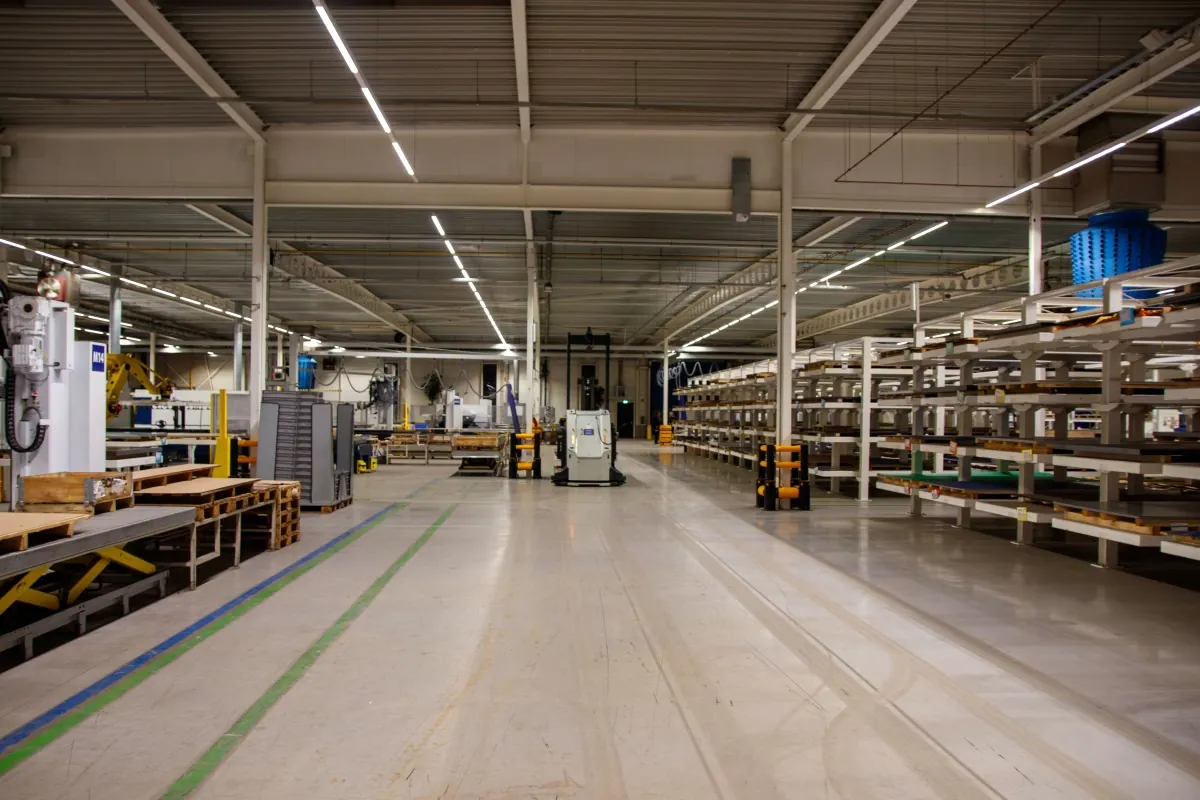
The three pillars of the intelligent factory
No single technology creates a truly smart factory. It is the convergence of three capabilities — intelligence, perception, and adaptive infrastructure — that creates manufacturing operations capable of autonomous optimisation at industrial scale.
- 01
Autonomous AI
Sets goals, plans actions, adapts to disruptions, and learns from outcomes — without waiting for human instruction
- 02
Computer Vision
Gives machines the ability to see, interpret, and act on visual data — detecting defects, monitoring safety, tracking flow
- 03
Smart Factory Systems
The connected infrastructure — IoT sensors, edge computing, digital twins — that feeds real-time data to AI and vision
From automation to autonomy: what AI actually does
Traditional automation follows rules. Autonomous AI goes further — it acts with purpose, adapts to changing conditions, and improves over time. In a smart factory, this means machines that don’t just execute tasks, but optimise processes, reconfigure workflows, and respond to disruptions without human intervention.
- 01
Goal-directed operation
Setting objectives based on high-level directives — optimising for throughput, quality, or efficiency without explicit step-by-step programming.
- 02
Dynamic planning and adaptation
Adjusting plans in real time as conditions change — machine faults, demand shifts, quality deviations — without stopping production.
- 03
Human-machine collaboration
Working alongside operators and other systems — anticipating needs, flagging anomalies, and escalating decisions that require human judgment.
- 04
Continuous learning from outcomes
Improving every cycle based on what worked and what didn’t — a system that gets measurably better over time without manual retraining.
Scenario — autonomous response to a bottleneck
- A robotic cell detects a production bottleneck forming at Station 3
- 1
- A robotic cell detects a production bottleneck forming at Station 3
- AI reroutes pending tasks to underutilised stations without stopping the line
- 2
- AI reroutes pending tasks to underutilised stations without stopping the line
- Logistics is notified automatically to adjust downstream delivery scheduling
- 3
- Logistics is notified automatically to adjust downstream delivery scheduling
- All of this happens without a single manual command — the factory adapts itself
- 4
- All of this happens without a single manual command — the factory adapts itself
Computer vision: giving machines the power to see
While autonomous AI provides the intelligence, computer vision gives machines their perceptual awareness. Visual data becomes a rich source of operational insight — enabling context-aware decision-making that was impossible with rule-based automation.
Real-time defect detection — catching quality issues at the point of production, not at end-of-line
Worker safety monitoring — detecting PPE compliance, restricted zone entry, and unsafe postures
Inventory and material tracking — knowing exactly where every component is without manual scanning
Predictive maintenance signals — spotting wear, vibration anomalies, and early failure indicators visually
Scenario — vision + AI quality response
- A vision system detects a micro-crack in a component at the inline inspection station
- 1
- A vision system detects a micro-crack in a component at the inline inspection station
- The AI agent halts the part, reroutes it to quarantine, and logs the anomaly with full context
- 2
- The AI agent halts the part, reroutes it to quarantine, and logs the anomaly with full context
- OEE quality metrics update instantly and engineering receives a root cause analysis alert
- 3
- OEE quality metrics update instantly and engineering receives a root cause analysis alert
- The defect model retrains on the new data — improving detection accuracy for the next shift
- 4
- The defect model retrains on the new data — improving detection accuracy for the next shift
The smart factory ecosystem
Smart factories are adaptive ecosystems combining four technology layers. AI-powered computer vision supports precision processes such as Paintless Dent Removal through accurate defect detection and quality control.
- 01
IoT sensors
Real-time data from machines, environment, and production — the nervous system of the factory
- 02
Cloud and edge computing
Scalable processing at the right layer — edge for real-time decisions, cloud for analytics and learning
- 03
Autonomous AI
The decision-making layer — turning sensor and vision data into autonomous corrective action
- 04
Computer vision
The perceptual layer — providing visual context that sensors alone cannot deliver
Why this matters — the strategic imperative
This convergence is not a technical upgrade — it is a strategic repositioning. Manufacturers that embrace these technologies gain durable advantages that compound over time.
Reduced waste and downtime — systems that detect and correct before failure
Greater agility — production lines that reconfigure without stopping
New business models — on-demand manufacturing and mass customisation at scale
Empowered workforce — operators guided by smarter tools, not replaced by them
- 01
Smart factory capabilities
Decision-making Autonomous Inspection 100% inline Adaptation Real-time Learning Continuous Human input On escalation Deployment 1 day
- 02
Related guides
Connected machines & OEE Data intelligence & OEE Local vs cloud for AI Robotics and vision