· 2 min read
Vision Systems for Battery Inspection: Quality & Safety.
Battery cells are safety-critical components in electric vehicles and energy storage systems. Traditional inspection cannot keep pace with production volumes or the precision required. AI vision provides fast, automated, 100% coverage — catching defects that manual inspection consistently misses.
Why vision systems are essential for battery inspection
As battery technologies become central to electric vehicles and renewable energy storage, the stakes of a missed defect are uniquely high. A surface crack, a misplaced electrode, or a faulty seal can cause battery failure — with consequences ranging from product recalls to safety incidents. Production volumes are high and rising, making 100% manual inspection both impractical and insufficient. AI vision solves all three problems simultaneously.
- 01
Microscopic defect detection
Identifies surface cracks, dents, corrosion, and contamination that compromise battery performance or create safety risks — invisible to manual inspection.
- 02
Assembly accuracy verification
Verifies correct placement of electrodes, separators, and casing components — preventing manufacturing defects before final assembly and sealing.
- 03
Dimensional and surface integrity
Automated measurement of cell dimensions detects deformation or swelling indicative of internal issues — before the cell reaches the pack assembly stage.
- 04
Real-time production feedback
Immediate defect detection enables rapid process adjustments — reducing waste and downtime by catching root causes before they produce further defective cells.
Key inspection applications
AI vision covers every critical quality checkpoint across the battery cell manufacturing and assembly line.
Surface defect detection — scratches, cracks, and foreign particles on battery cell surfaces
Welding and seal inspection — proper sealing and weld quality to prevent leaks and thermal failures
Label and marking verification — serial numbers, batch codes, and safety label presence and legibility
Dimensional and geometric checks — cell thickness, height, and shape consistency measurement
Electrode and component verification — missing or misplaced internal components detected before final assembly
Tab and terminal inspection — connection point integrity and correct geometry for safe electrical contact
Technologies used
High-resolution cameras with specialised lighting — optimised for reflective battery cell surfaces, detecting defects that standard lighting misses.
3D imaging and laser scanning — precise shape and volume measurement for dimensional compliance and swelling detection.
Machine learning trained on battery defects — models recognising complex defect patterns unique to cell and pack manufacturing.
MES integration — inspection results feed directly into your manufacturing execution system for real-time production control and traceability.
Benefits for battery manufacturers
Enhanced product safety — precise defect detection significantly reduces risk of battery failures and safety incidents
Boosted production efficiency — automated inspection accelerates throughput without compromising accuracy
Minimised waste and cost — identifying defects early reduces scrap rates and costly rework at later stages
Strengthened customer trust — consistently high-quality batteries reinforce brand reputation and meet industry standards
Regulatory compliance — full digital inspection records supporting automotive and energy industry standards
Scalable to volume — same platform handles growing cell production rates without additional inspection headcount
- 01
Key metrics
Inspection coverage 100% Inspection speed <0.5s Consistency 100% MES integration Included Deployment 1 day
- 02
Defects detected
Surface cracks Weld defects Seal failures Deformation Missing components Dimensional errors
- 03
Explore more
Related reading
More AI vision guides and case studies.
Case Study · Automotive Computer Vision & Injection Molding QC Read more
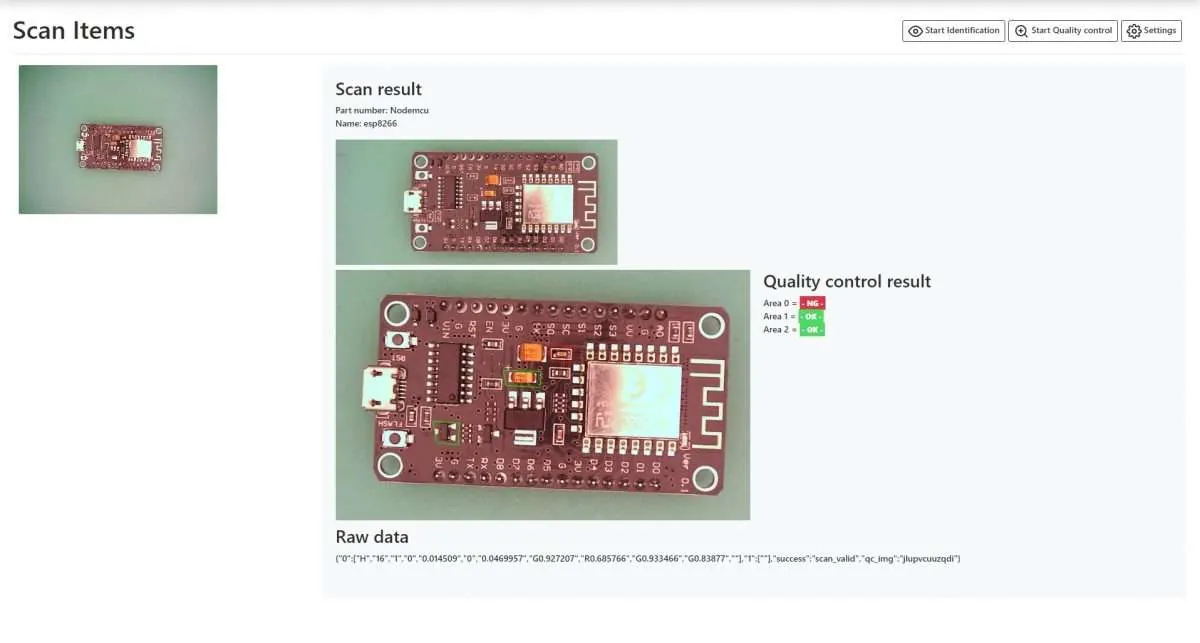
Case Study · Electronics Computer Vision for Micro Components & PCBs Read more
Guide · Industry 4.0
Connected Machines, AI & Computer Vision: Unlocking True OEE
Read more